
 Pay by Bank and Wero are both part of a broader evolution in the European payments landscape revolving around innovation and sovereignty, but they are based on very different architectures. This article dives deeper into these architectural differences to help fintech platforms, PSPs and regulated institutions get ready for the rapidly approaching future of payments.
As Europe enters a new phase of payment innovation, Open Banking-driven Pay by Bank is gaining momentum, while initiatives such as Wero aim to strengthen European payment sovereignty. Although both approaches enable bank-based, account-to-account transactions, their architectural foundations differ in meaningful ways.
Two Models within European Payments
Wero is designed as a European wallet initiative that facilitates consumer and merchant payments within a shared ecosystem.
As a wallet-based scheme, it introduces a dedicated consumer-facing payment layer, operates within a defined participation framework and ecosystem rules, and establishes a branded payment experience. In doing so, it represents an important step towards reinforcing European alternatives within the payments market.
Pay by Bank: Open Banking Infrastructure
In contrast, at IBANXS, we approach Pay by Bank from an infrastructure perspective. An infrastructure-based model provides programmable and secure bank connectivity that is embedded seamlessly within the organization’s existing platform environment to enable direct account-to-account payments.
There is no separate wallet layer, no competing consumer brand, no closed ecosystem and no mandatory wallet adoption. Instead, IBANXS provides direct and reliable bank connectivity across Europe through secure Open Banking APIs, fully aligned with PSD2 authentication standards.
Our infrastructure is built to support not only today’s Open Banking requirements, but also the continued evolution toward Open Finance. This ensures scalability, compliance and long-term architectural flexibility.
While both approaches enable account-to-account payments, their structural positioning within the payments ecosystem differs significantly. The comparison below illustrates these architectural distinctions more clearly.
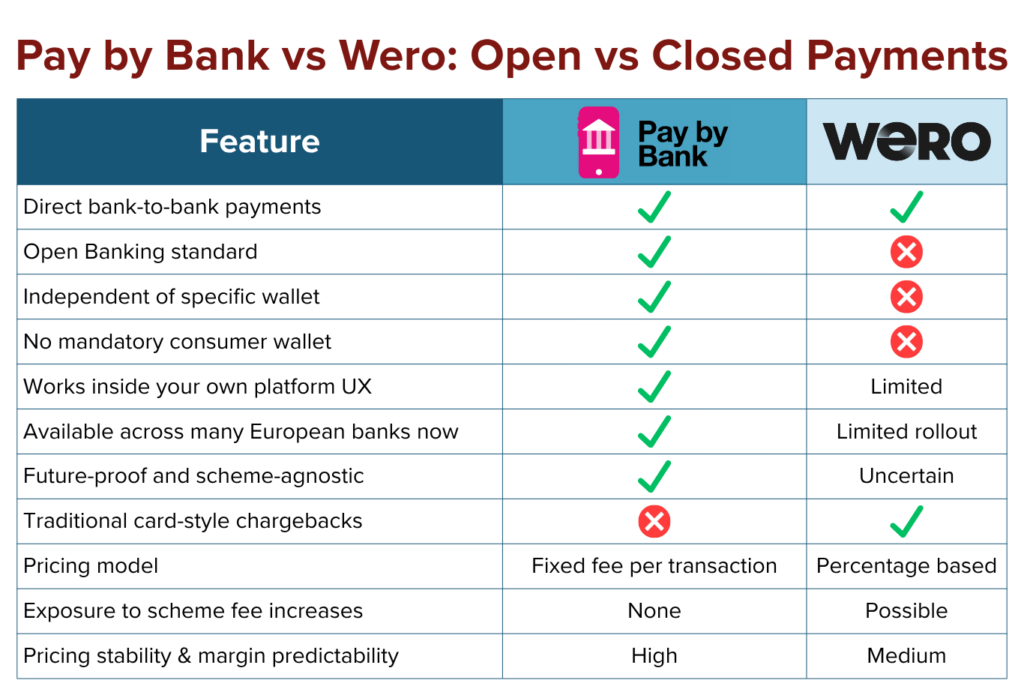
The fundamental distinction lies in the architectural layer: Wero operates as a consumer wallet scheme within a governed ecosystem, whereas Pay by Bank functions as embedded Open Banking infrastructure beneath the user interface. Wallet schemes create a branded payment layer; infrastructure models provide programmable connectivity that remains adaptable over time.
These structural distinctions directly influence platform control, integration strategy and long-term scalability.
Strategic Considerations
For software providers, fintech platforms, Payment Service Providers (PSPs) and regulated financial institutions, the immediate drivers behind the shift to account-to-account payment models are often financl: reducing chargeback exposure and improving cost efficiency.
Wero comes with scheme fees, percentage-based pricing, and chargeback risk – all of which directly impact margins and operational complexity. In contract, account- to-account payments offer settlement certainty and typically a fixed-fee structure, improving pricing stability and reducing dispute-related losses.
Beyond these short-term economic considerations, long-term strategic success depends on structural choices. Questions around ownership of the user experience, control over APIs and integration, regulatory alignment, and long-term scalability across Europe often play a central role. For many platforms, independence from scheme governance and the ability to retain architectural flexibility are equally important.
Understanding these architectural differences is therefore essential when organizations are evaluating how to position themselves for the next generation of European payments.
Building Sustainable European Payment Infrastructure
Both infrastructure-based Open Banking models and wallet-based initiatives contribute to the evolving European payments landscape. The most suitable approach ultimately depends on the organization’s strategic objectives and long-term platform vision.
At IBANXS, we believe European payment sovereignty is strengthened through open, interoperable and compliant infrastructure. By delivering secure Open Banking connectivity and real-time, account-to-account payments, we empower businesses across Europe to innovate with confidence.
If you would like to explore how Pay by Bank fit within your strategy, our team would be pleased to connect.